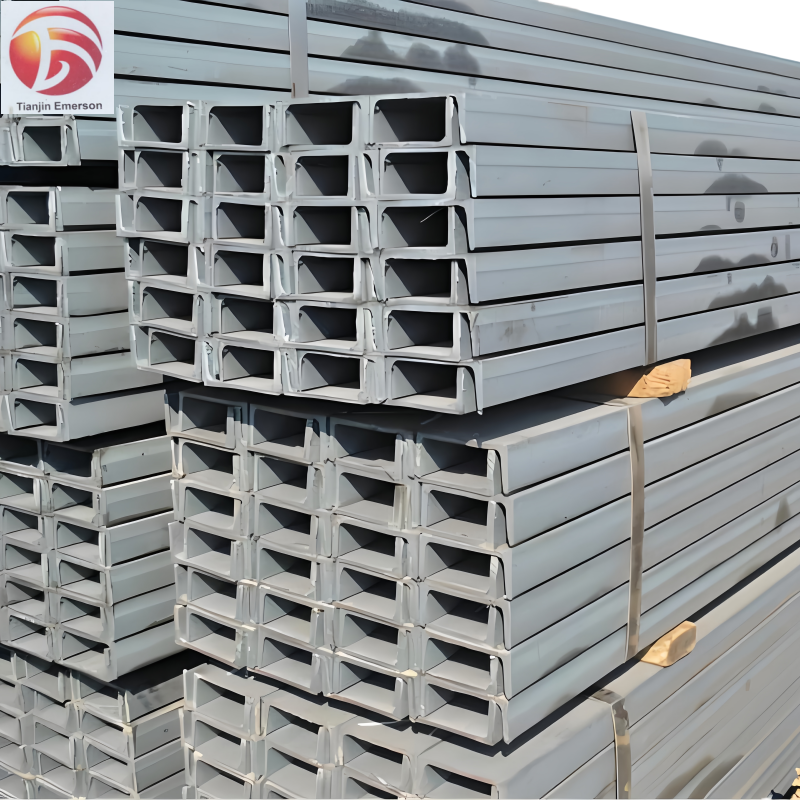
Channel steel is characterized by its distinctive C-shaped or U-shaped cross-section, formed by two parallel flanges connected by a vertical web. Its geometric structure offers three major advantages: high axial bending strength, convenient connection properties, and strong adaptability in frame and support structure construction. Standard hot-rolled channel steel is classified based on precise specifications of flange width, web thickness, and overall height. Common sizes range from small sections like 50mm × 30mm for light-duty framing to large sections such as 300mm × 90mm for primary structural beams, with thickness increasing proportionally to load-bearing requirements. The primary material is low-carbon steel, such as ASTM A36 or S235JR/S355JR, offering excellent weldability and strength suitable for conventional construction. For environments requiring enhanced corrosion resistance, stainless steel grades (e.g., 304) or pre-galvanized channel steel products are also available. Our factory maintains substantial inventory and supports custom specifications tailored to project timelines.
Channel steel finds extensive application across numerous industries, serving both as visible structural supports and as critical concealed support systems. It is indispensable in construction and civil engineering, industrial and mechanical fields, transportation, and infrastructure development. Such widespread demand necessitates equally comprehensive processing capabilities. Our facility supports cutting, bending, welding, drilling, and other fabrication processes. For components requiring modification, we achieve precise notches, cuts, and punched holes via CNC plasma cutting or drilling to facilitate connections. The structural form of channel steel supports multiple joining methods, with welding offering the most robust bond. Additionally, channel steel can undergo cold bending using press brakes to create custom brackets or curved support members, though careful selection of dies is essential to accommodate its open cross-section.
Successful fabrication of channel steel requires adherence to several critical technical points to ensure structural integrity and dimensional accuracy. First, connection design is paramount: bolted connections must be meticulously designed to avoid bolts being too close to flange or web edges; welded connections require controlled deformation through proper joint preparation and construction sequencing, particularly in long-span members. Second, due to its asymmetrical cross-section, channel steel is more susceptible to lateral torsional buckling than closed sections like steel pipes. Effective lateral bracing must be designed and implemented throughout the manufacturing assembly process and in the final installed state. Third, balanced staggered welding sequences must be employed during fabrication to minimize warping deformation of the section. For galvanized I-beams, the zinc coating in the weld zone must be ground prior to welding to prevent porosity and fume issues, followed by reapplication of surface protection post-welding.