
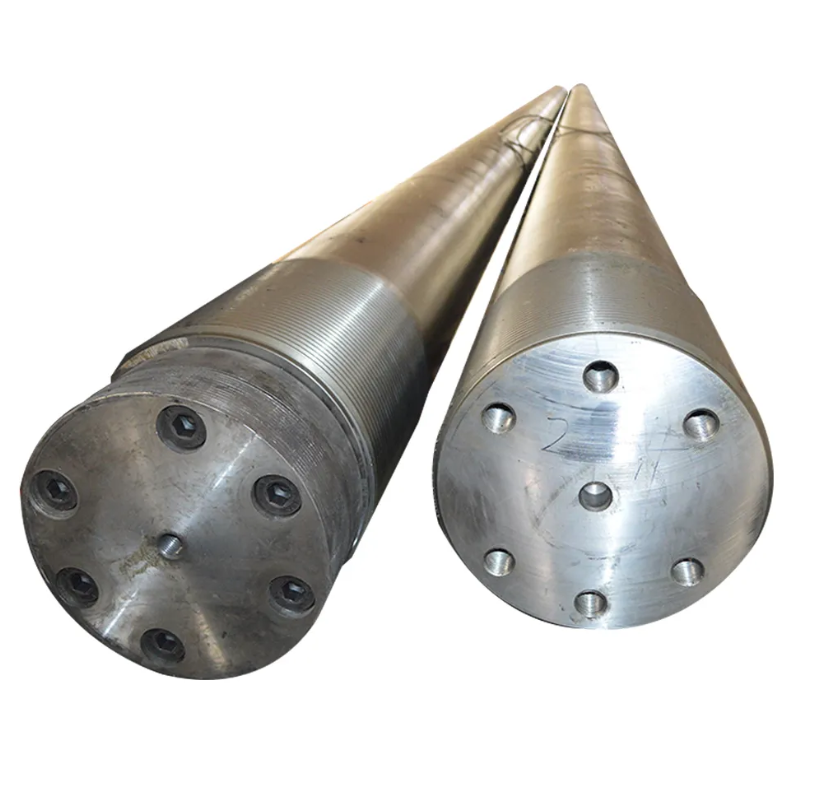
Critical Mechanical Functions of Round Bars: Shafts, Axles, and Fasteners
Rotating Component Design: How Round Bars Enable Reliable Shaft and Axle Performance
Round bar stock serves as the foundational material for critical rotating components—including transmission shafts, drive axles, and camshafts—where structural integrity under dynamic load is non-negotiable. Precision-drawn round bars deliver inherent concentricity, ensuring balanced rotation essential for high-RPM applications in automotive powertrains and industrial gearboxes. Engineers typically specify high-carbon steel grades like SAE 1045 for shafts requiring tensile strengths exceeding 700 MPa and Rockwell hardness above C28 to resist torsional stresses. In axle applications subject to cyclic bending, cold drawn round bars provide superior surface finish (Ra < 3.2 μm) and dimensional consistency (±0.05 mm), directly minimizing stress concentration points. Post-machining induction hardening further enhances wear resistance at bearing journals—extending service life by up to 40% in commercial vehicle drivelines, per tribology research.
Threaded Fastener Production: Precision Machining and Tolerance Control for Round Bar Stock
High-strength threaded fasteners—bolts, studs, and cap screws—rely on round bar stock with exceptional homogeneity, machinability, and internal soundness. Aerospace and automotive manufacturers prioritize continuous-cast round bars to eliminate internal voids that compromise thread rolling integrity. Tight diameter tolerances (±0.025 mm) in cold-finished stock enable efficient CNC turning, supporting UNF/ISO thread profiles with pitch accuracy under 0.01 mm. Alloy steels such as AISI 4140 undergo spheroidizing annealing to optimize chip formation during high-volume machining while balancing hardness (28–35 HRC) and ductility. For mission-critical assemblies—including engine blocks and suspension systems—fastener-grade round bars undergo 100% ultrasonic testing to detect inclusions that could initiate fracture under vibration loads exceeding 20 Gs. Surface preparation prior to plating improves corrosion resistance by 300% in salt-spray environments versus untreated alternatives.
Material Selection for Round Bars in High-Performance Mechanical Systems
Key Mechanical Properties: Tensile Strength, Fatigue Resistance, and Surface Integrity
Selecting round bar material for demanding mechanical applications hinges on three interdependent properties: tensile strength, fatigue resistance, and surface integrity. Tensile strength—the maximum stress a material withstands before failure—dictates load-bearing capacity; high-strength steels like SAE 1045 support forces exceeding 85 ksi (ASM International). Fatigue resistance determines longevity under repeated loading, especially in rotating or reciprocating parts where crack initiation begins at micro-defects or stress risers. Surface integrity—including hardness uniformity, absence of microcracks, and controlled roughness—directly governs wear behavior and interfacial performance in bearings, gears, and seals. Together, these attributes ensure dimensional stability, functional reliability, and predictable service life.
Comparative Performance: EN8, SAE 1045, and AISI 4140 Round Bars Under Load
EN8 (equivalent to AISI 1040), SAE 1045, and AISI 4140 represent progressively higher tiers of performance for mechanically loaded round bars. EN8 offers good machinability and moderate strength—suited for general-purpose shafts where cost and ease of fabrication are priorities. SAE 1045 delivers higher tensile strength (up to 110 ksi when quenched and tempered) and improved wear resistance, making it ideal for high-load axles and driveline components. AISI 4140 stands apart for applications demanding exceptional toughness and fatigue strength: its chromium-molybdenum composition yields torsional stress resistance 40% greater than EN8 and 25% lower notch sensitivity than 1045 under impact loading—key advantages for dynamic drivetrain and landing gear components.
Fabrication Methods and Their Impact on Round Bar Usability in Manufacturing
Hot Rolled vs. Cold Drawn vs. Forged Round Bars: Machinability, Tolerances, and Application Fit
The choice among hot rolled, cold drawn, and forged round bars reflects a balance between precision, performance, and cost. Hot rolled bars offer economical bulk supply with typical tolerances of ±0.3 mm but require extensive secondary machining for precision parts. Cold drawn bars achieve tighter dimensional control (±0.05 mm) and smoother surfaces (Ra < 3.2 μm), reducing post-processing time and enhancing fit in hydraulic cylinders, linear actuators, and precision shafts. Forged round bars develop directional grain flow aligned with load paths, boosting fatigue resistance by 15–30% over cast or wrought equivalents (ASM Handbook)—a decisive advantage in safety-critical connections like aircraft landing gear or heavy-duty crankshafts. Machinability also varies: cold drawn steels cut ~25% faster than hot rolled variants due to consistent hardness, whereas forged alloys often require specialized tooling and slower feed rates.
Heat Treatment Strategies to Maximize Round Bar Performance in Service Conditions
Quenching and Tempering for Gear, Bearing, and Actuation Interfaces
Quenching and tempering transforms raw round bar stock into a dimensionally stable, high-performance component capable of enduring cyclic loading, friction, and impact. Rapid quenching develops a hard martensitic structure, while controlled tempering relieves internal stresses and optimizes the hardness–toughness balance. This combination prevents surface pitting in gear teeth, spalling in bearing journals, and brittle fracture in actuation interfaces like camshafts and linkages. Precise control over soak time, heating rate, and cooling media ensures uniform case depth and core properties—minimizing distortion and maximizing service life. When applied correctly, this treatment sequence is indispensable for round bars operating in high-stress mechanical systems—from wind turbine gearboxes to high-performance engines.
FAQ
What are the main uses of round bars in mechanical systems?
Round bars are primarily used for shafts, axles, and threaded fasteners. They provide structural integrity and concentricity needed for high-performance rotating and stationary components.
Which materials are best suited for high-strength round bars?
Materials like SAE 1045 and AISI 4140 are commonly used for high-strength applications due to their excellent tensile strength, fatigue resistance, and surface integrity.
How does surface finish affect round bar performance?
A smoother surface finish minimizes stress concentration points and enhances the fatigue resistance, wear behavior, and uniformity in critical applications such as axles and bearings.
What's the difference between hot rolled, cold drawn, and forged round bars?
Hot rolled bars are cost-effective bulk material with looser tolerances. Cold drawn bars provide tighter tolerances and smoother surfaces, while forged bars offer superior grain flow and resistance to fatigue.
Why is heat treatment crucial for round bars?
Heat treatment, including quenching and tempering, improves hardness, toughness, and wear resistance, enabling round bars to withstand high stress, friction, and cyclic loading conditions.
Table of Contents
- Critical Mechanical Functions of Round Bars: Shafts, Axles, and Fasteners
- Material Selection for Round Bars in High-Performance Mechanical Systems
- Fabrication Methods and Their Impact on Round Bar Usability in Manufacturing
- Heat Treatment Strategies to Maximize Round Bar Performance in Service Conditions
- FAQ