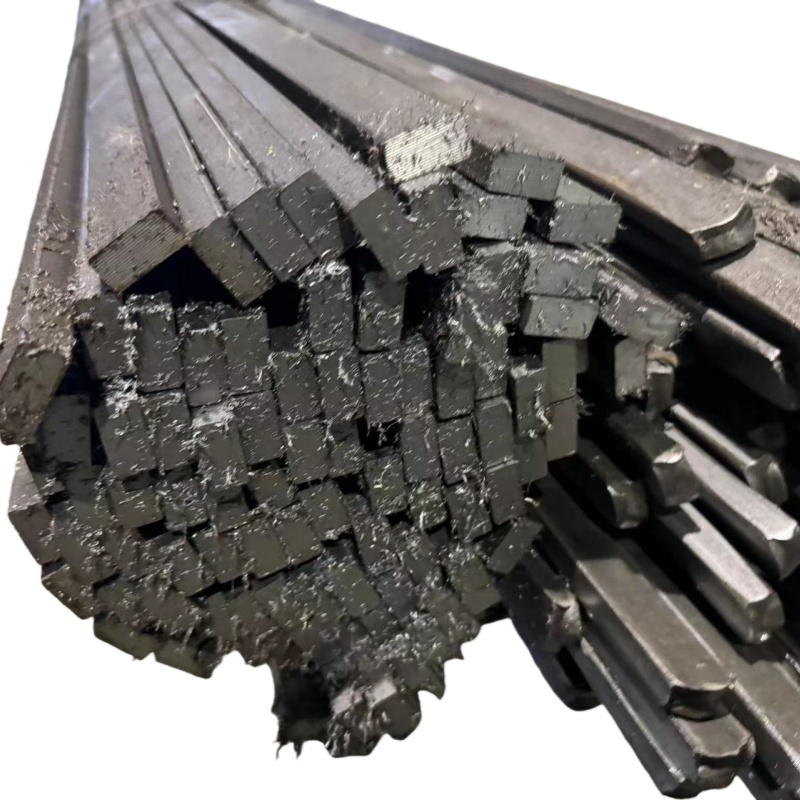
Flat steel is characterized by its rectangular cross-section, which provides ample welding or mounting surface area, offers linear strength along its length, and facilitates handling and machining. The performance and applicability of flat steel primarily depend on its material composition, which must be selected based on mechanical requirements and environmental conditions. The most common type is carbon steel flat bar, including grades such as ASTM A36 (general structural steel with a minimum yield strength of 36 kpsi) and 1018 (low-carbon steel with excellent weldability and machinability). For applications requiring high strength, wear resistance, or specific quenching properties, medium-carbon and alloy steels (e.g., 1045 or 4140) are employed, typically requiring subsequent heat treatment processes. For corrosive environments, stainless steel alloys are employed, with grades 304 and 316 being the most widely used due to their exceptional general corrosion resistance and chloride resistance. Additionally, aluminum alloy flat bars (such as 6061) are utilized for lightweight structural applications, while materials like brass are suitable for decorative or specialized electrical uses. Our company maintains inventory of flat steel in various materials and grades, providing optimal solutions for projects ranging from prototyping to high-volume production.
Additionally, our factory offers customized processing for flat steel. Using high-speed band saws or fiber laser cutting systems, we produce blanks of precise lengths. Based on customer-provided drawings, laser cutters can engrave simple or complex shapes and contours. Subsequently, CNC bending machines precisely form the flat steel into angle bars, channel sections, brackets, or custom shapes. This process ensures high repeatability while precisely controlling the material's inherent springback characteristics. For components requiring holes or slots, CNC machining performs drilling, punching, and milling to guarantee precise hole layout and assembly positioning tolerances. Connections between flat steel and other structural components are primarily achieved through professional welding. Carbon steel structures utilize MIG (GMAW) welding for high-strength, efficient connections. Stainless steel and aluminum components employ TIG (GTAW) welding to ensure exceptional quality and aesthetic appeal, with all weld strengths matched to the base material's strength.
The applications of processed flat steel are exceptionally diverse, serving both as concealed structural supports and visible architectural features. In building and civil engineering, it is utilized for seismic bracing, connecting plates (stiffening plates), masonry hanging angle steel, and reinforcement components for concrete formwork. Industrial machinery and transportation sectors rely on it for manufacturing robust frames, custom brackets, forklift tines, trailer side rails, and chassis components. It is equally indispensable in warehousing and material handling solutions, such as columns and support frames for heavy-duty shelving systems. Furthermore, within architectural metalwork, flat steel can be fabricated into streamlined handrails, balustrade frames, decorative trim, and custom furniture components.